Ever since the birth of hip-hop in 1973, the genre’s lack of representation of women has become more and more prominent (“Hip hop is born”).
The male-dominant industry created the term “female rapper” as a way to push women in the business into a separate category (Younger). Kind of like a sub-genre, if we must get technical.
Similar to the diversity issues female professionals experience in the workplace environment, women in the hip-hop industry find themselves dealing with sexist incidences that merely reflect the man’s need to continually be in power (Mora).
However, in the past several years, women have climbed to the top of the hip-hop charts and stole the spotlight from male artists.
Rico Nasty, Saweetie, Cardi B, and Lizzo are just some of the names that made their mark on the Billboard Hot 100 list in 2019 alone- being the highest total of the decade (Wurzburger).
After her initial entrance into the spotlight with track “Bodak Yellow” in 2017, it was anticipated by many listeners and critics that Cardi B would end up being just another one hit wonder (Rosa).
Thanks to the era of social media, Cardi B managed to go from being on reality television to No. 1 on the Billboard Hot 100 Chart in 2018 when her first studio album Invasion of Privacy dropped in the same year. She was also the first woman to have three No. 1 singles on the Billboard charts (Wurzburger).
Cardi B also won Best Rap Album at the 2019 Grammy Music Awards (Wurzburger).
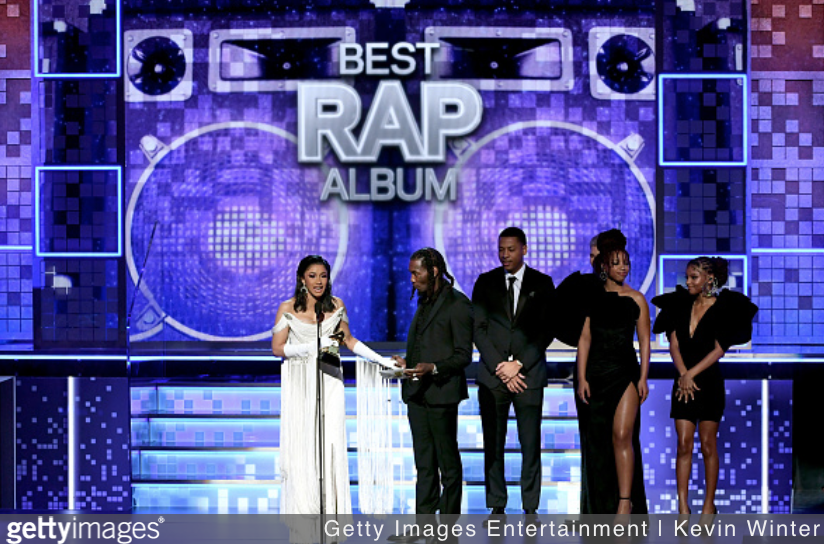
Photo Credits: Getty Images/ Kevin Winter
Embed from Getty Imageswindow.gie=window.gie||function(c){(gie.q=gie.q||[]).push(c)};gie(function(){gie.widgets.load({id:’3GhQEqF2Re11iDUQSIqdyw’,sig:’oo2lGx0yWC66HeNJZbflLWFfCQ_xVjgr7C7NZg9AfeI=’,w:’594px’,h:’396px’,items:’1097714342′,caption: true ,tld:’ca’,is360: false })});
Platforms like YouTube, Instagram, Twitter, and streaming services such as Apple and Spotify helped quadruple Cardi’s fan base, thanks to both her talent and distinctive personality (Rosa).
However, even with Cardi’s obvious milestones and successions for not only herself, but women in the hip-hop industry, many are quick to compare her to fellow rapper Nicki Minaj, who dominated the charts in the beginning of the decade (Mora).
From subtweets to public alterations, Cardi B and Nicki Minaj gave the public much reason to believe a certain rivalry is in the midst between the two.
Nicki Minaj raps, “Tryna make a new Nicki with a factory/They’ll never toe to toe on a track with me/There’ll never be another one after me/’Cause the skill levels still just a half of me,” in her song LLC, where she doesn’t hold back to remind the industry of the power and influence she holds (Mora).
It’s an interesting collection of lyrics that Nicki Minaj put out, as it continued to year-long feud between the two artists. If a male rapper were to voice their opinion on another artist, there is more freedom and less room for backfire as there is more room for competitive range without the worry of compromising their entire career (Mora).
It was during the 90s where women came together to form powerful hip-hop groups and make history. After that, women in hip-hop became more independent and went off to live out their own journeys (Mora).
It is easier nowadays for social media to pit female artists against each other, especially in the hip-hop industry. However, more and more women are joining together to form ultimate collaborations and support one another in such a misogynistic industry.
It’s not just up to men to change the way the hip-hop industry works. It’s important for women to support each other, especially when these feuds continue to just solidify men’s power in the industry (Younger).
It’s time we drop the term “female rapper.”
It’s time “rapper” also meant “all.”
Works Cited:
“Hip hop is born at a birthday party in the Bronx.” HISTORY, 8 Aug. 2019, https://www.history.com/this-day-in-history/hip-hop-is-born-at-a-birthday-party-in-the-bronx. Accessed 24 Feb. 2020.
Younger, Briana. “Is Rap Finally Ready to Embrace Its Women?” The New Yorker, 7 Dec. 2018, https://www.newyorker.com/culture/cultural-comment/is-rap-finally-ready-to-embrace-its-women. Accessed 24 Feb. 2020.
Mora, Maria. “HOW PATRIARCHY & LACK OF DIVERSITY IN HIP-HOP CAUSE FRICTION BETWEEN FEMALE RAPPERS.” HYPEBAE, 21 Nov. 2018, https://hypebae.com/2018/11/diversity-hip-hop-female-rappers-cardi-b-nicki-minaj-feud-patriarchy. Accessed 24 Feb. 2020.
Wurzburger, Andrea. “From Regula, Degula to Super Stardom: A Timeline of Cardi B’s Meteoric Rise to Fame.” People, 11 Oct. 2019, https://people.com/music/cardi-b-meteoric-rise-fame-timeline/?slide=6305874#6305874. Accessed 24 Feb. 2020.
Rosa, Christopher. “Nicki Minaj and Cardi B’s Relationship: A Complete Timeline.” Glamour, 30 Oct. 2018, https://www.glamour.com/story/nicki-minaj-cardi-b-timeline. Accessed 24 Feb. 2020.
 Voice of Women